Composer of the Month: Giovanni Pierluigi da Palestrina (Renaissance Period)


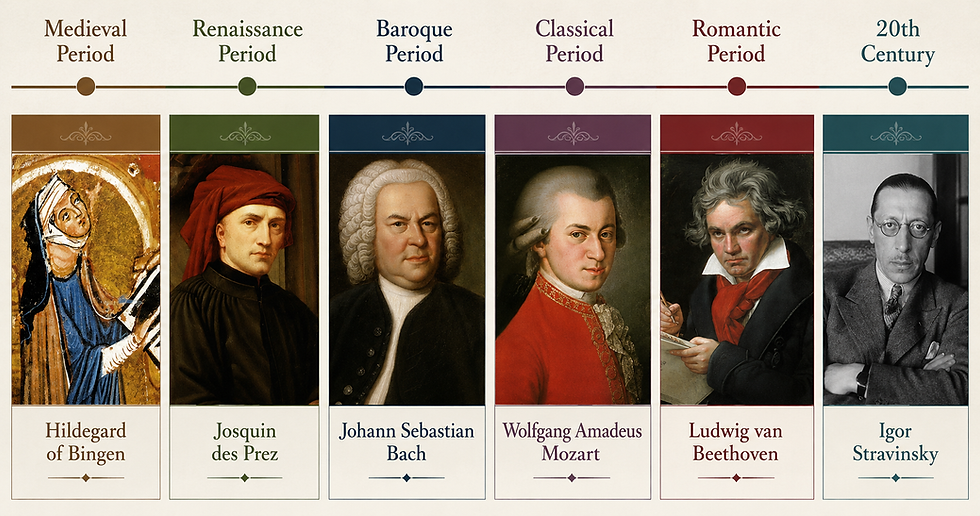
Giovanni Pierluigi da Palestrina (c. 1525 - 1594), affectionately known as the “Prince of Music,” remains one of the most luminous figures of the Italian Renaissance. Born in the quiet hill town of Palestrina near Rome, he began his life of music as a choirboy around 1537. He absorbed the rich polyphonic traditions of northern European masters like Josquin des Prez while training under local teachers. By 1544, he was an organist and choirmaster at the Cathedral of St. Agapito. He later married and began raising a family.
In 1551, his former bishop—now Pope Julius III— appointed him choirmaster of the prestigious chapel at St. Peter’s Basilica, making him the first native Italian to hold the post. Palestrina dedicated his groundbreaking first book of masses (1554) to the pope. Over the decades, he directed music at major Roman churches, briefly joined the Sistine Chapel choir (only to be dismissed for being married), and returned triumphantly to St. Peter’s in 1571, where he served until his death.
Yet his personal life was scarred by heartbreaking tragedy. Between 1572 and 1580, devastating plague outbreaks claimed his brother, two musically gifted sons, and beloved wife. Grief-stricken and seriously ill, Palestrina briefly considered entering the priesthood. Instead, in 1581, he married a wealthy widow, whose business savvy finally brought financial security and unleashed a flood of creativity for Palestrina.
Palestrina’s output is astonishing: more than 105 masses, over 300 motets, 68 offertories, 72 hymns, 35 Magnificats, around 140 madrigals, and Missa Papae Marcelli, his most famous work. He shaped Catholic sacred music for generations.
When he died, he was buried the same day at St. Peter’s with his own five-part Libera me Domine sung in his honor. Centuries later, Giuseppe Verdi hailed him as “the real king of sacred music.”