American Music Evolution: An Overview

Updated: Aug 30

How did music become so different across genres? This year, our Music Study will focus on that evolution.
A Journey Through Genres
Classical - medieval roots
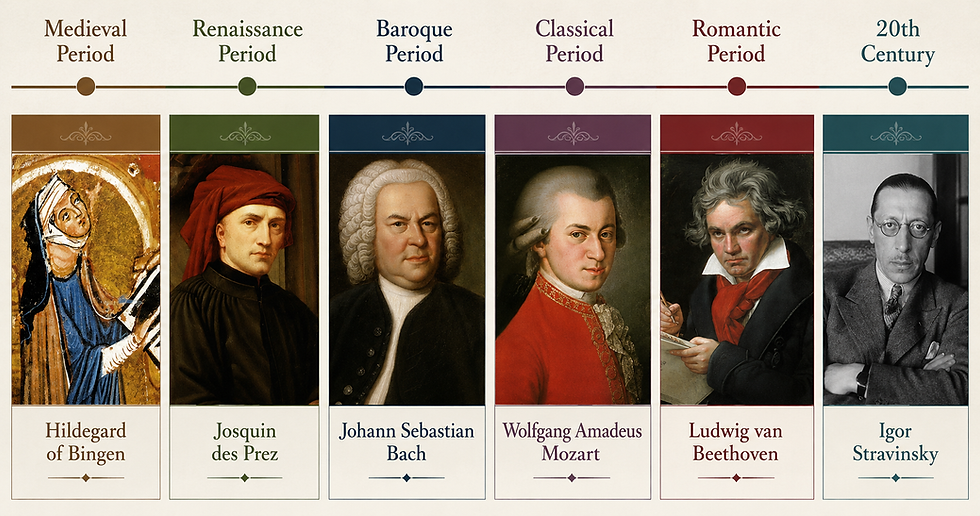
Classical music laid the foundation. Its notation and structures created a rule book that underpins nearly everything. Defining features include balanced phrasing (e.g., 4-bar groups), large-scale forms (sonata-allegro, symphony, fugue), and precise notation/composition with little improvisation.
Blues - late 19th/early 20th century
Blues loosened classical rules, setting the stage for nearly all later American music. It was the first major break from classical tonality—introducing "impure" pitches and cyclical repetition from African traditions.
Gospel - early 20th century
Gospel fused sacred lyrics with a blues feel, influencing soul and rock music. It adapted blues scales, harmony, and jazz elements for church through spirituals.
Jazz - 1910s
Jazz added ragtime and brass bands to blues roots, extending chords, swing rhythms, syncopation, and improvisation. It shifted the emphasis in real-time creation and harmonic color over fixed forms.
Country Western - 1920s
Country Western drew from Appalachian storytelling, lyrics, and acoustic strings. It had a parallel folk path from European roots with a blues crossover. It kept harmony simpler and narrative-focused, unlike the complexity of jazz, and influenced rock via rockabilly.
Rock - mid-1950s
Rock music drew from blues with power chords, electrified distortion, strong backbeat, and verse-chorus forms. It simplified some elements while adding volume and attitude.
Electronic - 1960s
Electronic music shifted to synthesizers with repetitive beats, and prioritized groove and texture over notation. It shifted from acoustic instruments to technology-driven sounds. While it incorporated prior rhythms and harmony, it prioritized groove and production, and influenced rap beats.
Rap/Hip-Hop - 1970s
Rap/Hip-Hop emphasized rhythm and lyricism over melody, with heavy bass creating a culture of beats and rhymes. It sampled recycled earlier theories while emphasizing spoken rhythm and urban storytelling. Its minimalist harmony allows lyrics and beat to dominate, and it is built on funk/disco/electronic foundations.