

Global Music Notation: Southeast Asia
- Rachel Beard

- Feb 1
- 1 min read
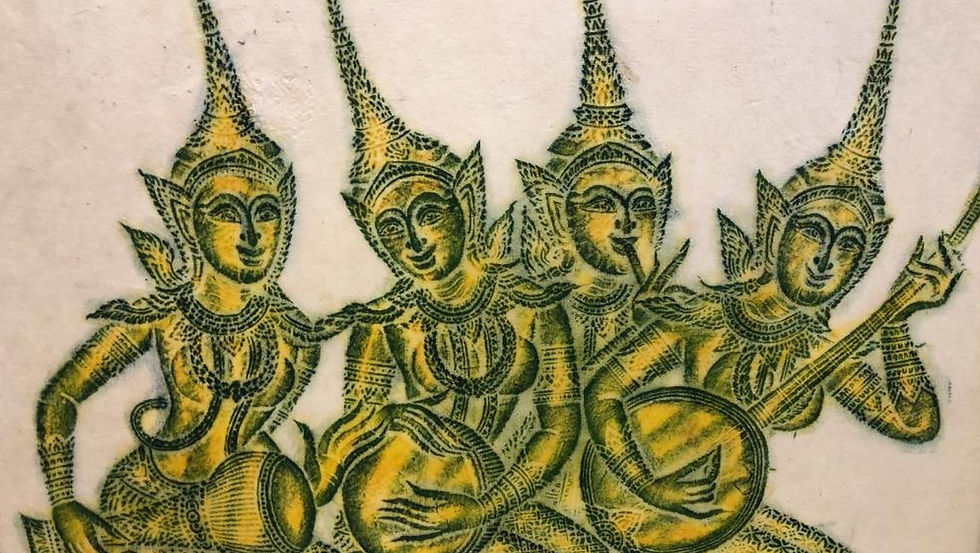
The classical music traditions of Thailand, Laos, and Cambodia share deep historical roots, which are shaped by Indian, indigenous Mon-Khmer, Chinese, and Indonesian influences, resulting in closely related instruments, ensembles, and performance practices.
Music structures emphasize layered melodies, cyclical forms, and tempo changes signaled by percussion rather than harmonic progression. Across this region, music is closely integrated with dance, drama, and ritual performances.
Despite its tonal sophistication, this music has historically been transmitted orally. Written notation serves mainly as a memory aid rather than a definitive score. Early attempts at notation date back to European observers in the 17th century, and more recently in the 20th century, promoted by Thai scholars and institutions. Even today, mastery of this music depends primarily on close teacher-student transmission, which reinforces the living, performative nature of this region’s musical traditions.


